

Family Law
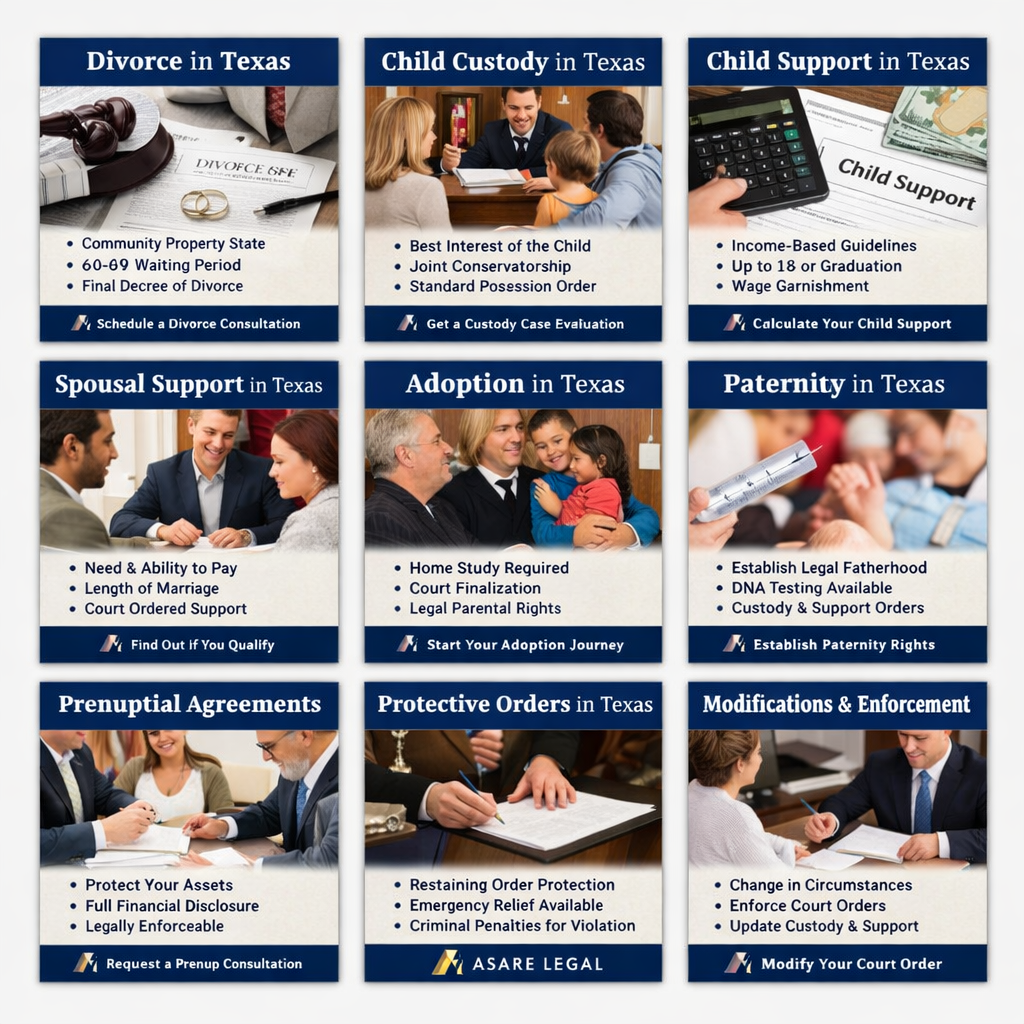
Family Law Services
Family law cases are deeply personal and often emotionally challenging. At Asare Legal, we provide compassionate and strategic representation tailored to Texas law. Whether you are facing divorce, custody disputes, or need legal protection, our firm guides you every step of the way.
1. Divorce (Dissolution of Marriage)
Overview:
Divorce is the legal process of ending a marriage. It involves resolving issues such as property division, child custody, and support.
Texas Guidelines:
Texas is a community property state, meaning assets acquired during marriage are typically divided fairly.
Texas does not recognize legal separation you must file for divorce to divide assets.
A Final Decree of Divorce legally ends the marriage after court approval.
Process:
- Initial consultation and case evaluation
- Filing the Petition for Divorce
- Serving the other spouse
- Temporary orders (if needed)
- Negotiation or mediation
- Final court hearing or trial
- Issuance of Final Decree of Divorce
Benefits:
- Legal closure and clarity
- Fair division of assets and debts
- Establishment of custody and support arrangements
2. Child Custody & Visitation
Overview:
Child custody determines who will make decisions for the child and where the child will live.
Texas Guidelines:
Custody is called “conservatorship” in Texas, and the courts prioritize the best interest of the child.
Texas favors joint managing conservatorship (shared parenting)
Standard visitation follows a Standard Possession Order (e.g., weekends, holidays)
Process:
- Filing a custody petition
- Court evaluates the best interests of the child
- Temporary custody orders (if necessary)
- Mediation between parents
- Court hearing or agreement approval
- Final custody order
Benefits:
- Stability and structure for the child
- Clear parental responsibilities
- Protection of parental rights
3. Child Support
Overview:
Child support ensures that both parents contribute financially to the upbringing of their child.
Texas Guidelines:
Based on monthly net income percentages: 20% (1 child), 25% (2), 30% (3), etc.
Applies to income up to a capped amount (adjusted periodically).
Support typically continues until age 18 or high school graduation.
Process:
- Filing for child support
- Financial disclosure from both parents
- Calculation based on state guidelines
- Court order issuance
- Enforcement (if necessary)
Benefits:
- Financial stability for the child
- Fair allocation of parental responsibility
- Legal enforcement options
4. Spousal Support (Alimony)
Overview:
Spousal support provides financial assistance to a spouse during or after divorce.
Texas Guidelines:
- Limited and not automatically granted
- Based on factors like:
- Length of marriage
- Financial need vs ability to pay
- Domestic violence history
Process:
- Request for spousal support
- Financial evaluation of both parties
- Determination of need and ability to pay
- Negotiation or court ruling
- Issuance of support order
Benefits:
- Financial transition support
- Fair economic balance post-divorce
- Protection for lower-earning spouse
5. Adoption
Overview:
Adoption is the legal process of becoming the permanent parent of a child.
Texas Guidelines:
Requires background checks and home study
Governed by Texas Family Code and child welfare agencies
Finalized by court order
Process:
- Application and background checks
- Home study evaluation
- Matching with a child
- Placement of the child
- Court finalization hearing
- Issuance of adoption decree
Benefits:
- Legal parent-child relationship
- Permanent family stability
- Emotional and legal security
6. Paternity (Establishing Parentage)
Overview:
Paternity cases establish the legal father of a child, which affects custody, visitation, and support.
Texas Guidelines:
Establishes legal rights for fathers
Required before custody/support orders if unmarried parents
Process:
- Filing a paternity petition
- DNA testing (if disputed)
- Court review of evidence
- Legal determination of parentage
- Orders for custody/support
Benefits:
- Legal rights for fathers
- Access to benefits for the child
- Clarification of parental responsibilities
7. Prenuptial & Postnuptial Agreements
Overview:
These agreements define how assets and debts will be handled during or after marriage.
Texas Guidelines:
Must include full financial disclosure
Must be voluntary and properly executed
Enforceable under Texas contract law
Process:
- Financial disclosure from both parties
- Drafting the agreement
- Review by both parties’ attorneys
- Signing and notarization
- Legal enforcement if needed
Benefits:
- Asset protection
- Reduced conflict in divorce
- Financial transparency
8. Domestic Violence & Protective Orders
Overview:
Protective orders provide legal protection for individuals facing abuse or threats.
Texas Guidelines:
Courts can issue temporary and final protective orders
Family violence impacts custody decisions
Violations can result in criminal penalties
Process:
- Filing for a protective order
- Emergency/temporary order issuance
- Court hearing
- Presentation of evidence
- Final protective order decision
Benefits:
- Immediate safety and protection
- Legal enforcement against abuser
- Peace of mind
9. Modifications & Enforcement
Overview:
When circumstances change, existing court orders can be modified or enforced.
Process:
- Filing a motion to modify or enforce
- Demonstrating change in circumstances
- Negotiation or mediation
- Court hearing
- Updated or enforced court order
Benefits:
- Keeps orders fair and relevant
- Ensures compliance
- Protects rights and obligations