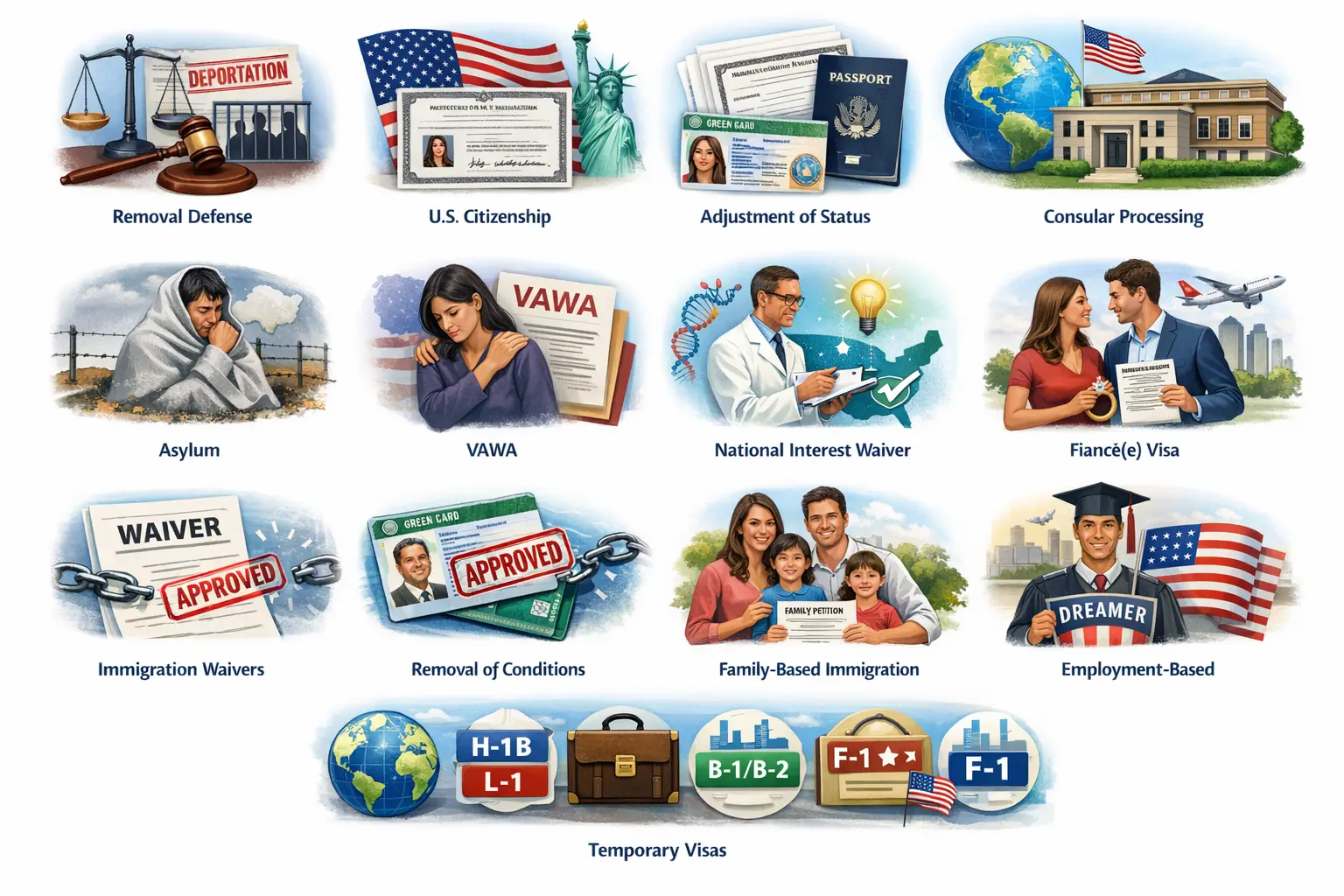

Immigration
Immigration Services & Benefits
At Asare Legal, we provide comprehensive immigration services to individuals, families, and businesses. Navigating immigration law can be complex, but we are committed to guiding you through every step with clarity and confidence.
Below is an overview of the most common immigration services and the process involved in each.
1. Removal Defense (Deportation Defense)
Overview:
Removal Defense, also known as deportation defense, refers to representing individuals in immigration court who are facing deportation from the United States. Since the creation of the modern immigration court system under the Immigration and Nationality Act (INA) of 1952, immigrants have had the right to present a defense before an immigration judge.
Our firm helps clients seek relief such as asylum, cancellation of removal, adjustment of status, or waivers to remain legally in the U.S. while protecting your right to remain in the United States.
Process:
Receive a Notice to Appear (NTA)
Attend Master Calendar Hearing
Identify relief options (asylum, cancellation, adjustment, etc.)
Submit applications and supporting evidence
Attend Individual (Merits) Hearing
Judge issues a decision
Appeal (if necessary)
2. U.S. Citizenship (Naturalization)
Overview:
The process of becoming a U.S. citizen through naturalization dates back to the Naturalization Act of 1790. Today, lawful permanent residents can apply for citizenship after meeting residency and good moral character requirements. Becoming U.S. citizens allows individuals to enjoy the full rights and protections under the US constitution. We assist clients through every step — from filing Form N-400 to interview preparation — ensuring they achieve the rights and privileges of full U.S. citizenship.
Process:
Determine eligibility (usually 3–5 years as a green card holder)
File Form N-400
Attend biometrics appointment
Complete citizenship interview and civics test
Receive decision
Take Oath of Allegiance
3. Family-Based Immigration
Overview:
U.S. citizens and permanent residents can sponsor certain family members for green cards.
Process:
File Form I-130
Wait for visa availability (if applicable)
Apply via Adjustment of Status or Consular Processing
Attend interview
Receive green card
4. Adjustment of Status (Green Card in the U.S.)
Overview:
Adjustment of Status allows eligible individuals already in the United States to apply for lawful permanent residency without returning to their home country. This process was formalized under the Immigration and Nationality Act (INA) to streamline the transition for qualifying immigrants.
We guide clients in preparing and filing Form I-485, gathering supporting documentation, and attending interviews for a successful Green Card approval.
Process:
Determine eligibility (family, employment, asylum, etc.)
File Form I-130 (if applicable) and Form I-485
Attend biometrics appointment
Receive work permit/travel authorization (optional)
Attend USCIS interview
Receive green card approval
5. Fiancé(e) Visa (K-1 Visa)
Overview:
The K-1 Fiancée Visa was introduced in 1970 to allow U.S. citizens to bring their foreign fiancés to the United States for marriage. Once married within 90 days of arrival, the foreign spouse may apply for adjustment of status.
Our firm helps couples reunite by managing every stage of the K-1 visa process — from filing to interview and eventual Green Card application
Process:
File Form I-129F
USCIS approval
Case sent to U.S. consulate abroad
Fiancé(e) attends visa interview
Enter the U.S. on K-1 visa
Marry within 90 days
Apply for Adjustment of Status
6. Consular Processing (Green Card Outside the U.S.)
Overview:
Consular Processing is the method for obtaining a U.S. immigrant visa while outside the United States. This process is managed by U.S. consulates and embassies worldwide and became standardized with the development of the Department of State’s National Visa Center. It is also for individuals outside the U.S. applying for immigrant visas through a U.S. consulate. Our team coordinates between U.S. immigration authorities and overseas consulates to ensure your visa application proceeds smoothly.
Process:
File immigrant petition (I-130 or I-140)
Case transferred to National Visa Center (NVC)
Submit fees and civil documents
Complete DS-260 application
Attend consular interview abroad
Receive immigrant visa and enter the U.S.
7. Removal of Conditions (2-Year Green Card)
Overview:
Conditional permanent residence was introduced under the Immigration Reform and Control Act of 1986 to prevent marriage fraud. After two years, conditional Green Card holders must file Form I-751 to remove conditions and obtain permanent residency.
We guide couples and individuals — including those filing jointly or based on waiver grounds — through this critical step toward secure permanent status.
Process:
File Form I-751 within 90 days before expiration
Submit evidence of bona fide marriage
Attend biometrics appointment
Attend interview (if required)
Receive 10-year green card
8. Asylum
Overview:
Asylum protections were first codified in U.S. law under the Refugee Act of 1980, aligning with international refugee conventions. It allows individuals fleeing persecution based on race, religion, nationality, political opinion, or membership in a particular social group to seek protection in the U.S. We provide compassionate representation to asylum seekers, helping them gather evidence, prepare for interviews, and secure safety in the United States.
Process:
File Form I-589 (within 1 year of entry, unless exceptions apply)
Attend biometrics appointment
Attend asylum interview or court hearing
Provide evidence of persecution
Receive decision
Apply for green card after 1 year (if approved)
9. VAWA (Violence Against Women Act)
Overview:
Passed in 1994, the Violence Against Women Act (VAWA) allows certain abused spouses, children, and parents of U.S. citizens or permanent residents to self-petition for lawful status without their abuser’s knowledge.
VAWA allows victims of abuse by a U.S. citizen or permanent resident spouse, parent, or child to apply independently for immigration benefits. We help survivors of domestic abuse file VAWA petitions confidentially and with dignity, ensuring their protection and independence.
Process:
File Form I-360 (self-petition)
Submit evidence of abuse and relationship
Receive prima facie determination (if applicable)
Apply for work permit
File for adjustment of status (if eligible)
Attend interview (if required)
Receive green card
10. National Interest Waiver (NIW)
Overview:
The National Interest Waiver (NIW) is a special category of employment-based immigration that began under the Immigration Act of 1990. It allows individuals with advanced degrees or exceptional ability to obtain permanent residency without employer sponsorship if their work benefits the national interest of the United States. We assist professionals, researchers, and entrepreneurs in preparing persuasive NIW petitions highlighting their national contributions.
Process:
-
Demonstrate advanced degree or exceptional ability
-
Show work has substantial national importance
-
Prove benefit of waiving job offer/labor certification
-
File Form I-140
-
File Adjustment of Status or Consular Processing
-
Attend interview (if required)
-
Receive green card
11. Employment-Based Immigration
Overview:
Employers can sponsor foreign workers for temporary or permanent employment in the U.S.
Process:
Labor certification (PERM) if required
File Form I-140
Wait for priority date (if applicable)
File Adjustment of Status or Consular Processing
Attend interview
Receive green card
12. DACA (Deferred Action for Childhood Arrivals)
Overview:
Provides protection from deportation and work authorization for eligible individuals brought to the U.S. as children.
Process:
Meet eligibility requirements
File Forms I-821D, I-765, and I-765WS
Attend biometrics appointment
Receive decision
Renew every 2 years
13. Temporary Visas (Nonimmigrant Visas)
Overview:
Temporary visas allow individuals to stay in the U.S. for a specific purpose.
Common Types:
H-1B (specialty workers)
L-1 (intra-company transfer)
B-1/B-2 (visitor visas)
F-1 (students)
Process:
- Determine visa category
- File petition (if required)
- Complete DS-160 application
- Attend consular interview
- Enter the U.S.
- Maintain visa status
14. Immigration Waivers
Overview:
Immigration waivers have long been part of U.S. immigration law, providing forgiveness for certain immigration violations, such as unlawful presence or misrepresentation. Common waivers include the I-601, I-601A, and I-212 forms.
We evaluate each client’s circumstances to determine eligibility and craft strong waiver applications demonstrating hardship and merit.
Process:
Identify grounds of inadmissibility
Determine waiver eligibility
File appropriate waiver (I-601, I-601A, etc.)
Provide evidence of extreme hardship to qualifying relative
USCIS review
Decision issued
Continue with visa or green card process
For a complete list of all US Immigration services and benefits, visit https://www.uscis.gov/forms/all-forms